
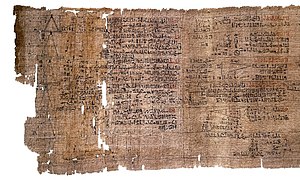
The problem is written on the Rhind papyrus, now housed in the British museum in London, and looks like this:

(For those of you who can't read hieratic, ancient Egyptian, writing) In english the problem reads:
- Houses 7
- Cats 49
- Mice 343
- Ears of wheat 2,401
- Hekats 16,807
What does this mean?
The writing alone does not provide many clues as to what the puzzle is. It was noticed that the numbers are 7, 7x7 = 49, 7x7x7 =343 etc. but again this did not provide many clues to the relation between the words and numbers.
It took a stroke of genius from someone studying the papyrus to make a connection between these numbers and the well known riddle "As I was going to St Ives".
- As I was going to St Ives
- I met a man with seven wives
- Every wife had seven sacks
- Every sack had seven cats
- Every cat had seven kits
- Kits, cats, sacks, wives.
- How many were going to St Ives?
- However in the ancient Egyptian case the puzzle would read: Seven houses each contains
seven cats. If each cat catches seven mice and if each mouse eats 7 ears of wheat. If sown each ear of wheat would have produced 7 hekats of wheat.
Why is this particular problem important?
This problem is massively important as it is the first recorded example in history of people doing mathematics for recreational purposes. It shows that even 3000 years ago there were people curious about maths and wanted to test their intellect by setting others these sort of riddles.
It is fascinating to think that some of the mathematical puzzles humans complete everyday, for example sudokus, could be studied by future historians in the same way as we study this problem from the past.
It is fascinating to think that some of the mathematical puzzles humans complete everyday, for example sudokus, could be studied by future historians in the same way as we study this problem from the past.

No comments:
Post a Comment